Beyond the Product: The Untapped Potential of Business Model Innovation
You’ve built a better mousetrap. Your product is faster, cheaper, and more reliable than anything else on the market. So why aren’t you winning?
Here’s the uncomfortable truth:
Product superiority doesn’t guarantee business success anymore. In today’s digital economy, features get copied in months instead of years.
Competitors reverse-engineer your innovations before you’ve recovered your R&D costs.
Business model innovation is where the real competitive advantage hides. It’s not about what you sell. It’s about how you sell it, who pays for it, and how you capture value over time.
What Business Model Innovation Actually Means
Most executives think innovation means better features or faster performance. But that’s only half the equation.
The real opportunity is redesigning how you create and capture value.
Breaking Down the Jargon
Business model innovation sounds like consultant-speak. But the concept is simple. It’s changing how you make money, not just what you sell. Think Hilti.
They expanded into Fleet Management, a tool‑as‑a‑service model where customers pay a monthly fee for tool use plus service and repairs.
Same tools, completely different business.
The key is understanding two separate ideas:
- Value creation
- Value capture
Value creation is the benefit your customer gets. Value capture is the money you make from delivering that benefit. These two things don’t always match up.
And that mismatch can kill your business.
The Four Quadrants of Business Health
Every company sits in one of four positions. Here’s where you might be:
| Position | Value Creation | Value Capture | What It Means |
|---|---|---|---|
| The Nightmare | High | Low | You deliver massive value but can’t monetize it. Lots of happy users, no revenue. |
| The Monopolist | Low | High | You extract money without innovating. You’re safe until someone disrupts you. |
| The Commodity Trap | Low | Low | You’re stuck in price wars with no differentiation. Urgent pivot needed. |
| The Ideal | High | High | You solve real problems AND capture fair value. This is where you want to be. |
The Nightmare quadrant is more common than you think. Startups with millions of users and zero revenue. Legacy companies with great products but commoditized pricing.
Moving to The Ideal means redesigning your profit formula.
Adobe did this when they switched from one-time software sales to monthly subscriptions. Same creative tools, radically different money machine.
Two Practical Frameworks for Reimagining Your Business
You can’t redesign what you can’t see clearly. These two frameworks give you a structured way to deconstruct your current business and design something better.
Here’s when to use each one:
| Framework | Best For | Key Strength |
|---|---|---|
| St. Gallen Navigator | Generating fresh ideas when you’re stuck | Cross-industry pattern matching |
| Business Model Canvas | Strategic planning and team alignment | Visualizing how all pieces connect |
1. The St. Gallen Magic Triangle
The St. Gallen Business Model Navigator gives you a structured way to think about change. It breaks your business into four questions:
- Who? Which customers are you serving?
- What? What problem are you solving for them?
- How? How do you create and deliver that solution?
- Value? How do you generate revenue and manage costs?
Here’s the breakthrough insight:
90% of “innovative” business models aren’t new. They’re recombinations of 55 existing patterns. Nespresso didn’t invent the razor-and-blade model.
They just applied Gillette’s century-old pattern to coffee machines.
This means you don’t need to invent anything. You need to steal smart. Look at patterns from other industries and apply them to yours.
2. The Business Model Canvas
The Business Model Canvas takes a different approach. It maps your business across nine building blocks.
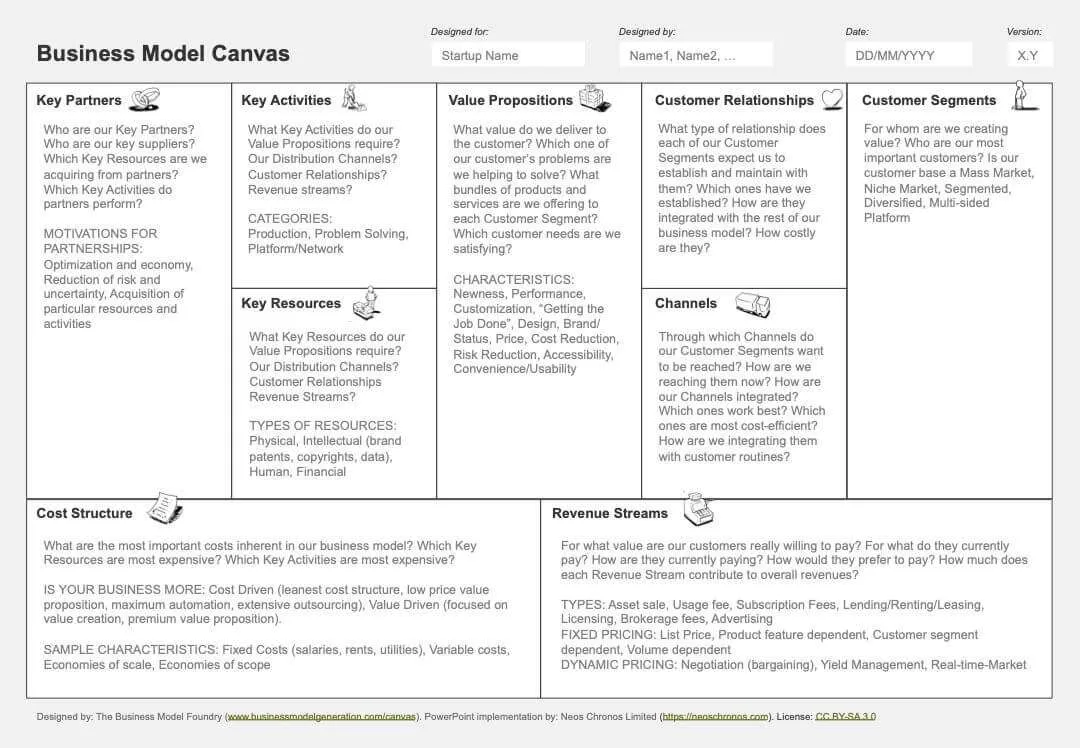
The nine blocks cover:
- Customer segments and relationships
- Value propositions and delivery channels
- Revenue streams and cost structure
- Key resources, activities, and partnerships
The Canvas works best for visualization. It gets your whole team looking at the same picture. You can map your current state on one canvas and your future state on another.
Use St. Gallen when you need new ideas. Use the Canvas when you need to design and test those ideas. They’re complementary, not competing.
Proven Patterns That Actually Work
Theory is helpful. But real examples show you what’s possible.
Here are the patterns driving the most successful business transformations today.
From Selling Products to Selling Outcomes
Rolls-Royce transformed aerospace with a simple shift. Instead of selling jet engines, they sell “power by the hour.”
Airlines pay a fixed rate for every hour the engine runs. Rolls-Royce owns the engine and handles all maintenance. If it breaks, the airline stops paying and Rolls-Royce eats the repair cost.

This flipped the entire incentive structure.
Rolls-Royce now profits from building engines that never fail. They invested heavily in sensors and predictive maintenance. They built a data moat competitors couldn’t cross.
Hilti did something similar with construction tools. Job sites lose thousands of dollars when a drill breaks and delays work. So Hilti stopped selling drills.
Now they sell guaranteed uptime. Contractors pay monthly for a fleet of tools. If something breaks, Hilti replaces it immediately.
The customer conversation shifted from “price per drill” to “cost of downtime.” Hilti captured significantly more value while locking in long-term contracts.
Digital Economy Patterns
Freemium works best when distribution costs are low and your unit economics still work with scale, even though content/licensing costs can rise with usage.
Give the basic version away free. Charge for premium features. Spotify does this perfectly. Free users get music with ads. They also become a viral marketing channel.

Lock-in creates switching costs that trap customers in your ecosystem. Apple mastered this. Buy an iPhone, then a Mac, then an iPad. Now your photos sync across devices.
The ecosystem’s tight integration, shared services, and convenience create real switching costs. Your family shares an iCloud account. Leaving means losing all that integration.
You’ve invested too much to switch. And that’s not an accident. It’s by design.
Two-sided marketplaces connect two customer groups and capture value from the transaction. Airbnb doesn’t own hotels. Uber doesn’t own cars. They just facilitate the match and take a cut.
The more hosts join Airbnb, the more valuable it becomes for guests. The more guests join, the more hosts want to list. Network effects create a moat.
Circular Economy Models
Trash-to-cash turns waste into revenue. Freitag makes designer bags from old truck tarps. Industrial symbiosis lets one factory’s waste heat power another factory.
This isn’t just green marketing. It’s a legitimate cost advantage when raw materials are free. Product-as-a-service reduces material intensity through maximizing asset utilization.
Philips owns the lighting fixtures at Amsterdam’s Schiphol Airport. The airport pays for light (measured in lux), not bulbs.

This incentivizes Philips to build fixtures that last decades. They design for easy repair and modular replacement. It’s the opposite of planned obsolescence.
Philips makes more money when they build products that never need replacing.
Patagonia runs a resale marketplace for used gear. IKEA buys back old furniture. They capture margin on the same physical product multiple times.
And they prevent customers from buying cheaper alternatives from competitors.
Adobe’s Brave Leap (and the J-Curve That Almost Killed Them)
In the early 2010s, Adobe faced a growth ceiling. Photoshop and Illustrator were industry standards. But they sold for $1,800+ as boxed software.
That high price fueled piracy. It excluded hobbyists and small studios. Revenue spiked every 18 months at release, then crashed between versions.
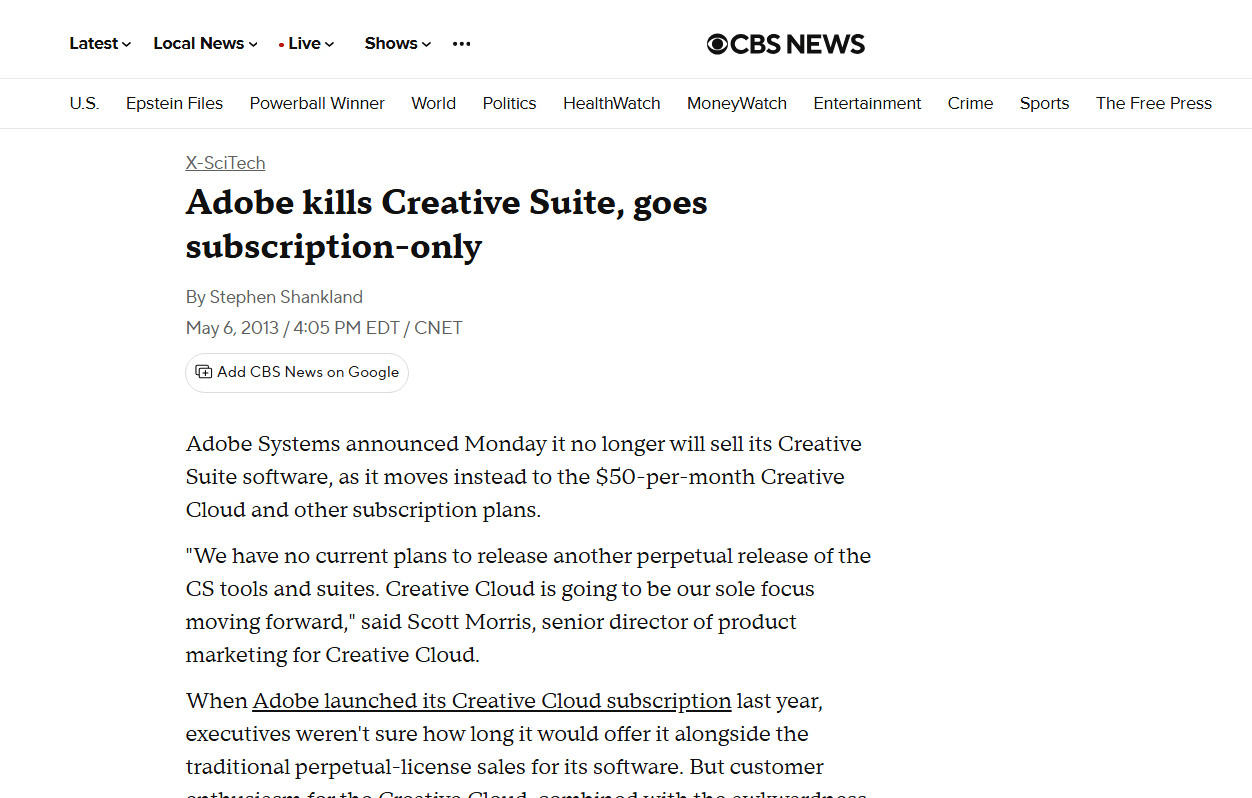
In May 2013, Adobe shifted Creative Suite to a subscription-first model and priced Creative Cloud around $50/month on an annual plan.
Wall Street panicked. Revenue immediately plummeted. A customer who used to pay $1,800 upfront now paid $50. Adobe’s stock dropped as analysts predicted disaster.
CFO Mark Garrett had to educate investors on the J-curve phenomenon. Short-term revenue drops. Then it recovers. Then it goes exponential as subscriptions compound.
Adobe introduced new metrics.
Annual Recurring Revenue (ARR) replaced unit sales. Monthly Active Users replaced install base. They were measuring a completely different business.
The gamble paid off. Revenue became predictable. The lower price expanded the market massively. Piracy dropped because the software required cloud validation.
Today, Adobe’s market cap has grown exponentially. The same products, delivered through a different model, unlocked entirely new value.
How to Actually Do This (A Four-Phase Roadmap)
Transforming your business model isn’t a single decision. It’s a structured process that moves from understanding your current state to testing new approaches in the real world.
Here’s the roadmap that works:
Phase 1: Initiation
Map your current business model using the Canvas or St. Gallen framework.
Conduct a “death ground” analysis. What external forces (regulation, technology, competitors) threaten your current model?
Define your ambition level. Are you optimizing the core business or building a new growth engine?
Phase 2: Ideation
Select 6-8 patterns from industries completely different from yours.
If you manufacture machinery, ask “How would we operate as a freemium business?” Force yourself to think outside industry norms.
Look for analogies. “We want to be the Netflix of textbooks” or “the Uber of plumbing.” These comparisons spark new thinking.
Phase 3: Integration
Check internal consistency. If you move to subscriptions, can you survive the J-curve? Do you have cash reserves for the revenue valley?
Check external consistency. Does this solve a real customer problem better than alternatives?
Map capability gaps. What new skills (data analytics, customer success teams) do you need to hire or build?
Phase 4: Implementation
Start with a Minimum Viable Business Model. Test your riskiest assumption first. Usually that’s “Will customers actually pay?“
Launch in a pilot market. Contain geographic or segment risk. Use feedback loops to refine before scaling globally.
Overcoming the Internal Immune System
Your biggest barrier isn’t competition. It’s your own organization’s immune system attacking anything unfamiliar.
Most business model transformations fail not because the new model is flawed, but because the existing organization rejects it.
The current system is designed to protect what’s working today, not explore what might work tomorrow. Three strategies can break through this resistance:
- Structural separation: Create an independent unit with its own P&L that reports directly to the CEO
- Incentive realignment: Shift compensation from volume metrics (units sold) to value metrics (customer lifetime value, churn rate)
- Strategic cannibalization: Target different customer segments initially, design complementary offerings, and accept that disruption is inevitable
The structural separation is critical. Middle management will kill new initiatives that threaten their existing business.
You can’t drive a service transformation while paying sales teams for product volume. The incentives need to match the model.
Accept the cannibalization reality. If your new model is superior, it will eventually eat the old business. Better you own that transition than hand it to a competitor.
As Clayton Christensen said, “If we don’t cannibalize ourselves, someone else will.”
The Strategic Choice Ahead
Product features are easy to copy. A business model woven into your culture and customer relationships creates a moat competitors can’t cross.
From Hilti to Adobe, the companies dominating their industries didn’t just build better products. They built better profit formulas.
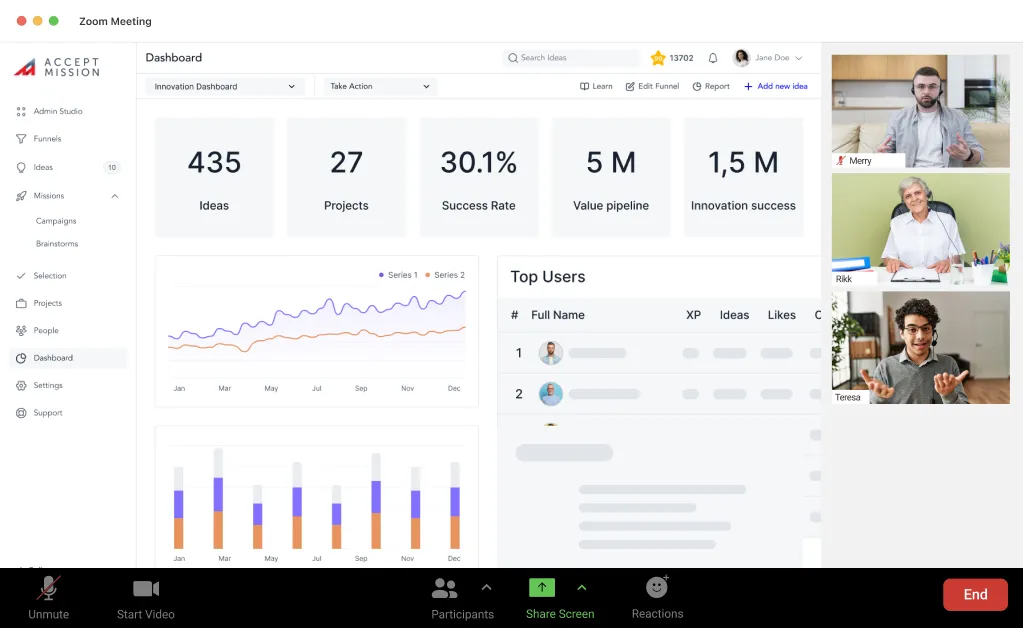
Accept Mission provides the infrastructure to manage this transformation systematically:
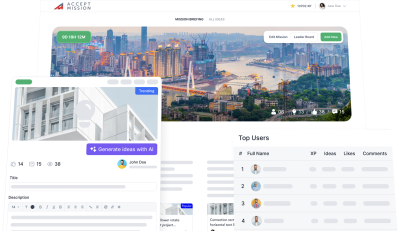
- Launch targeted campaigns to gather ideas across your organization
- Use AI-powered scoring to evaluate new business model concepts against strategic criteria
- Build innovation funnels that move ideas from validation to implementation
- Track project progress, ROI, and strategic fit with real-time dashboards
- Engage teams through gamification and collaborative tools
- Integrate seamlessly with your existing business systems
Accept Mission turns the theoretical frameworks discussed in this article into practical workflows.
Instead of scattered spreadsheets and endless email threads, you get a single platform where business model innovation happens systematically.
Ready to move beyond product innovation? Book a demo today and see how Accept Mission can help you build the business model that competitors can’t copy.












 English
  Dutch
Dutch  Portuguese
  Spanish
  French
  German
  Arabic