The High Cost of Missed Opportunities: Calculating the ROI of an Idea Management Platform

Most organizations treat innovation like a creative hobby. It’s the thing teams do when they have extra time and budget.
But innovation isn’t a nice-to-have expense. It’s a critical financial investment with measurable returns.
The companies still using suggestion boxes and spreadsheets aren’t just behind the curve. They’re actively bleeding money through what experts call the “Cost of Inaction” (COI).
This cost shows up in three devastating ways:
- Disengaged employees who stop contributing
- Wasted administrative hours managing chaotic processes
- Failed products that never should have launched
The return on investment for idea management platforms is multidimensional, with companies seeing immediate returns through administrative automation, strategic ROI through faster time-to-market, and defensive ROI through improved retention.
The Invisible Hemorrhage
The status quo feels safe. It feels like you’re saving money by avoiding new software purchases.
But the status quo isn’t free. It’s a slow, invisible drain on your organization’s most valuable assets: your people, their time, and your market position.
When Your Workforce Checks Out
We’ve moved past the “Great Resignation.” Now we’re in the era of the “Great Resistance.”
Employees don’t quit outright in this phase. They just stop caring. They show up, do the minimum, and mentally check out because they’ve learned their contributions don’t matter.
The financial impact is devastating. Companies with disengaged employees see productivity plummet by nearly 30%.
On the flip side, organizations that actively engage their workforce generate 21% greater profitability. That’s not a small difference. That’s the gap between industry leaders and everyone else.
Here’s what disengagement actually costs in dollars:
- Turnover expenses: Replacing a single entry-level employee costs upwards of $15,000
- Retention gap: Companies that solicit and respond to feedback experience 14.9% lower turnover rates
- Innovation drop: Ignored employees are 4.5 times less likely to contribute innovative ideas
But the damage goes deeper than these numbers suggest.
Research shows that workplace “ostracism” (being ignored or excluded) is often more harmful to employee well-being than harassment.
When someone shares an idea, and it disappears into a black hole, they learn a lesson. They learn to stay quiet. They learn to keep their best insights to themselves.
You’re paying them full salary for a fraction of their intellectual capacity. That’s not efficiency. That’s waste.
An idea management platform fixes this with transparent feedback loops. Even rejected ideas get acknowledged with clear reasoning. Employees see their contributions taken seriously.
This validation transforms potential detractors into active stakeholders. It turns the great resistance into the great engagement.
Manual Innovation Is Expensive Innovation
Many teams manage innovation through Excel or Google Sheets. It feels practical and cost-effective.
But manual processes have a hidden tax. It’s called “administrative friction,” and it’s eating your budget alive.
Knowledge workers already spend 88% of their week on communication and task management rather than deep work.
When you add manual innovation tracking on top of that, managers can lose 30-50% of their time just maintaining spreadsheets.
The numbers get worse at scale. Government agencies alone lose an estimated $38.7 billion every year to outdated manual processes.
Private enterprises aren’t much better. They just hide the waste across multiple departments.
Here’s what that waste looks like in practice:
- Data entry burden: Hours spent copying ideas from emails into cells, then moving them between tabs
- Version control chaos: Multiple copies of the “master” spreadsheet floating around with conflicting data
- Error rates: 88% of spreadsheets contain errors that compromise analysis
- Lost ideas: When employees leave, their local files disappear forever
The bigger problem is duplication. Without a centralized repository, teams solve the same problems twice.
- Your Singapore office spends three months researching a solution.
- Your Berlin office does the exact same research six months later because they never knew Singapore had already tried and failed.
That’s not collaboration. That’s burning money because you can’t see across your own organization.
Manual processes also kill speed. In markets where first-mover advantage matters, the delay between idea and decision costs millions.
While your team manually consolidates feedback from email threads, your competitor’s automated workflow has already moved their idea to prototype stage.
They launch three months earlier. They own the market.
Innovation Failure: The Million-Dollar Product Graveyard
Every year, companies introduce nearly 30,000 new products. 95% of them fail.
These aren’t just small startups with bad ideas. These are well-funded companies with experienced teams:
- Google Glass
- New Coke
- Colgate Kitchen Entrées
They failed not from lack of funding but from lack of proper vetting. They failed because the right voices never entered the conversation early enough.
Manual or non-existent idea management processes restrict who gets to contribute. This increases groupthink and creates blind spots.
When only the loudest voices in the conference room get heard, you miss the warning signs.
If Google had crowdsourced feedback from diverse internal and external communities before launching Glass, they might have caught the privacy concerns and usability issues that killed it.

Instead, they spent millions on a product nobody wanted.
An idea management platform brings more voices into the validation process. It enables rapid hypothesis testing before major capital deployment.
Take note that this doesn’t guarantee success, but it dramatically lowers the failure rate.
The ROI here isn’t just about launching winners. It’s about avoiding expensive losers before they drain your R&D budget.
Calculating Hard ROI
CFOs want concrete numbers. They want returns that show up on financial statements.
This is “Hard ROI.” It’s the measurable, quantifiable value that justifies the investment without relying on fuzzy cultural benefits.
Administrative Time Savings
The easiest ROI to calculate is the time your team stops wasting on manual administration. Here’s a real-world example that shows how one small improvement can deliver massive returns.
A hospital reception team spent 20 minutes manually entering patient data for each of the 10 daily patients. That’s 200 minutes per day of pure data entry.
An employee suggested using iPads with an app called “FastForm” to sync data automatically. The idea came through the innovation platform.
Here’s the math:
- Manual cost: 20 minutes × 10 patients = 200 minutes (3.33 hours) per day
- Annual time: 3.33 hours × 261 working days = 869 hours per year
- Financial cost: 869 hours × $15/hour = $13,050 in annual labor cost
- Digital solution cost: $300 (iPad + app license)
- ROI: ($13,050 – $300) ÷ $300 = 4,250% return
That’s one idea from one employee. An enterprise platform captures and enables hundreds of these improvements.
But the platform itself also generates direct savings. It eliminates the hours innovation managers spend manually collecting, organizing, and tracking ideas.
Modern platforms automate collection, tagging, routing, and notifications.
If your innovation manager currently spends 15 hours per week wrestling with spreadsheets and emails, and the platform cuts that to 3 hours, you save 624 hours annually.
At a manager salary of $100 per hour, that’s $62,400 in direct administrative savings. In many cases, this single benefit covers the entire platform license cost.
The formula is simple:
Savings = (Hours saved weekly × 52 weeks × Hourly rate) – Platform cost
This is your baseline Hard ROI. Everything else is upside.
Preventing the Reinvention Tax
In R&D-heavy industries, duplication is a silent budget killer.
Without a central repository, your Berlin team spends $100,000 testing a hypothesis while your Singapore team does the same thing a year later.
$100,000 was wasted because knowledge was trapped in files and emails. An idea management platform provides a searchable database of all past ideas, tests, and outcomes.
When your Singapore researcher types in their hypothesis, they instantly see Berlin already tried it. They read the results, understand why it failed, and pivot to something new.
This is “cost to duplicate” methodology. You calculate ROI based on the expense you avoided:
R&D ROI = (Cost of redundant projects avoided + Value of accelerated launch) ÷ Platform cost
When teams build on past learnings instead of starting from scratch, products also reach market faster. That speed advantage translates directly to revenue capture.
New Products from New Ideas (The Revenue Engine)
The most powerful Hard ROI comes from net new revenue. The platform stops being a cost center and becomes a revenue engine.
Syngenta, a global agricultural technology company, used an innovation platform to crowdsource solutions for complex R&D problems.

The results: 182% ROI with payback under two months, confirmed by Forrester Research.
They opened challenges to external partners and academic researchers, accessing cognitive surplus beyond their internal team.
Xaxis, a programmatic media agency, saw a 178% lift in campaign ROI from platform-sourced innovations, plus 20% higher sales velocity and 23% higher unit velocity.
Their innovations were entirely new targeting strategies that increased client spending and retention.
The attribution model is straightforward:
Revenue ROI = (New product revenue attributed to platform – Platform cost) ÷ Platform cost
In high-value R&D contexts, this can yield returns in the hundreds or thousands of percent. A single “blockbuster” idea can pay for the platform for years.
Building Your Business Case
Now let’s talk about how you actually build the business case. This framework gets CFO approval.
It’s based on best practices from ROI institutes and successful platform implementations across industries.
Step 1: Establish Your Baseline Investment
Start with calculating the Total Cost of Ownership (TCO) for the platform. This includes everything, not just the license fee.
Direct costs:
- Annual software license fees
- Implementation and setup fees
- Initial training costs for administrators and users
- Integration costs if connecting to existing systems
Indirect costs:
- Administrator time (estimate FTE percentage)
- Internal marketing to promote adoption
- Ongoing training and support resources
Be thorough here. Understating costs weakens your credibility when the real bills come in.
A realistic TCO for a mid-sized enterprise might range from $50,000 to $150,000 in year one, with lower annual costs after implementation.
Step 2: Project Your Hard Savings
Now calculate the quantifiable returns. Use conservative estimates to maintain credibility.
Component A – Administrative Time Savings:
Identify how many hours per week your team currently spends on manual innovation management. Include time spent on:
- Collecting ideas from various sources
- Data entry and spreadsheet maintenance
- Status updates and email responses
- Reporting and analysis
Multiply weekly hours saved by 52 weeks and the average hourly rate.
Example: 12 hours saved weekly × 52 weeks × $100/hour = $62,400 annual savings
Component B – Employee Churn Reduction:
Estimate your current turnover rate and the potential reduction from improved engagement. Research shows companies that actively solicit feedback see 14.9% lower turnover.
Use a conservative reduction estimate (3-5% is reasonable). Multiply the number of prevented departures by your average replacement cost.
Example: 1,000 employees × 5% reduction = 50 prevented departures × $15,000 = $750,000 savings
Component C – Process Improvements:
Review past improvement suggestions (if documented) or conduct interviews to identify potential savings.
Use the benchmark that high-performing organizations see about 44% of screened ideas successfully implemented. Estimate the value of typical process improvements in your industry.
Example: If 100 ideas are submitted annually and 44 are implemented, with average value of $5,000 per implementation = $220,000 in total process improvement value
Sum these three components for your total hard savings baseline.
Step 3: Estimate Revenue Upside
This is where you account for potential new products or services enabled by the platform. Be conservative here.
Component D – New Product Revenue:
Review your historical innovation success rate.
- What percentage of concepts typically make it to market?
- What’s the average revenue contribution?
Apply a probability-adjusted estimate. Don’t claim 100% of projected revenue if the success rate is actually 10-20%.
The “idea-to-launch ratio” helps calibrate this. A healthy innovation pipeline might see a 5:1 ratio from concept to prototype.
Example: Platform surfaces 50 qualified concepts annually. 10 become prototypes (5:1 ratio). 2 reach market (20% success rate). Average new product generates $500,000 in Year 1 revenue = $1,000,000 in attributable revenue
Be prepared to defend your assumptions. Show historical data if available. Use industry benchmarks if you don’t have internal history.
Step 4: Apply the 70-20-10 Reality Check
Before finalizing your ROI calculation, validate your assumptions using the 70-20-10 portfolio rule:
- 70% Core improvements: Low risk, moderate return (process optimizations, cost savings)
- 20% Adjacent opportunities: Medium risk, medium return (expansion into new markets or customer segments)
- 10% Transformative ideas: High risk, high return (breakthrough innovations)
Your ROI justification should primarily rely on the 70% category. These are the reliable, predictable returns.
Treat the 20% and 10% categories as upside. If they happen, great. If they don’t, your business case still holds.
This conservative approach builds credibility with finance teams who’ve seen too many inflated projections.
The final ROI formula:
ROI (%) = [(A + B + C + D) – TCO] ÷ TCO × 100
A worked example with realistic numbers:
- A (Admin savings): $62,400
- B (Turnover reduction): $750,000
- C (Process improvements): $220,000
- D (New product revenue): $1,000,000
- TCO (Total cost): $100,000
ROI = [($62,400 + $750,000 + $220,000 + $1,000,000) – $100,000] ÷ $100,000 × 100 = 1,932%
Even with conservative estimates (halving the figures), the ROI is still 916%. This explains why platforms with high adoption consistently achieve payback in months, not years.
The Strategic Mandate
The spreadsheet era is over. When 95% of products fail and competitive advantages last months instead of years, manual innovation management is financial negligence.
Syngenta achieved 182% ROI with payback under two months. Xaxis saw 178% campaign lift from platform-sourced innovations.
The cost of missed opportunities far exceeds the investment required.
Accept Mission eliminates the three catastrophic costs of manual systems: disengaged employees, wasted administrative hours, and failed products.
The platform’s AI-powered tools transform how organizations capture, develop, and implement breakthrough ideas.
Here’s how Accept Mission delivers measurable ROI:
- AI campaign builder creates complete innovation campaigns in minutes with ready-to-launch challenges
- Smart idea funnels with automated stage-gates move ideas from submission to implementation without manual tracking
- Gamification features boost engagement by 58% through leaderboards, points, and undercover mode
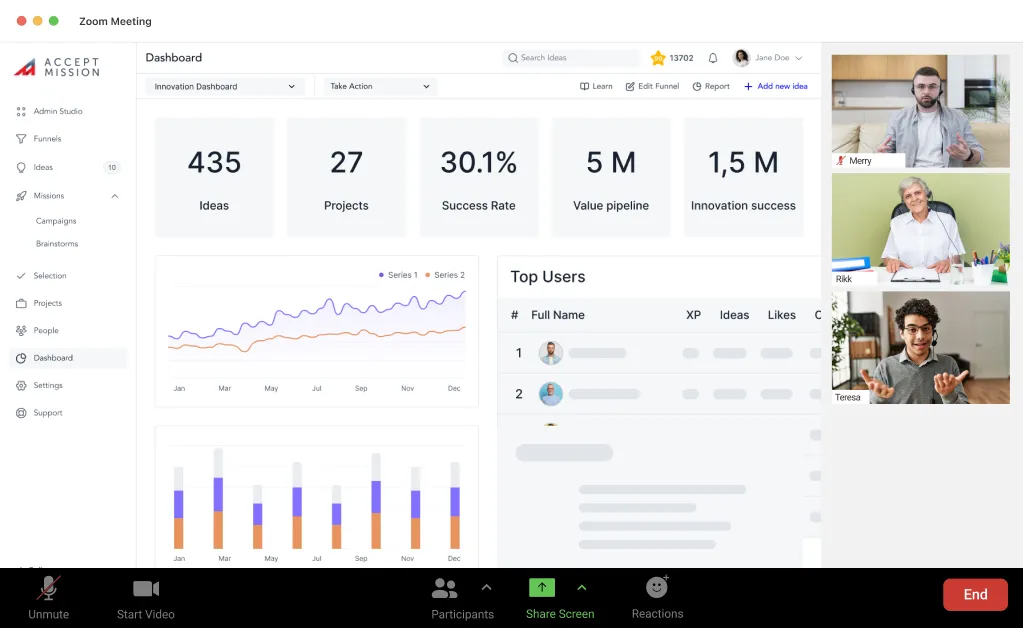
- Real-time dashboards track ROI, measure impact, and integrate with Power BI
- Automated workflows route ideas and trigger actions based on votes and scores
The platform scales from small pilots to global rollouts with the same intuitive interface.
Organizations report higher engagement, faster time-to-market, and measurable cost savings from employee-driven improvements.
The question isn’t whether you can afford an idea management platform.
The real question is whether you can afford to keep silencing your workforce while competitors turn their employees into innovation engines.
Book a demo with Accept Mission today and see how the platform delivers the hard and soft ROI your business case demands.

















 English
  Dutch
Dutch  Portuguese
  Spanish
  French
  German
  Arabic