
How to Run an Innovation Challenge That Drives Business Results

An innovation challenge is a structured competition where people crowdsource ideas to solve a specific business problem, unlike random brainstorming.
Here’s the hard truth. Most innovation challenges produce excitement and zero results.
They generate hundreds of ideas in a few weeks.
Everyone feels energized during the submission phase. Then the ideas disappear into what employees call an “organizational black hole.” Nothing gets implemented.
This is innovation theater. It looks impressive on the surface but delivers no business value.
The difference between theater and results comes down to three things:
- Connect to actual business strategy
- Invite the right participants
- Implement winning ideas with measurable impact
The Foundation: Setting Up Your Challenge for Success
Before you launch anything, you need a solid foundation. Three decisions will determine whether your challenge produces real results or just noise.
1. Define Clear Goals That Connect to Business Strategy
Start with a specific business problem, not a vague request for “innovation ideas.”
Bad challenge prompt: “Submit ideas to improve our business.”
Good challenge prompt: “How can we reduce customer onboarding time by 50% while maintaining quality?”
It’s nice to involve senior stakeholders early as they can identify high-impact areas and sponsor implementation later.
Ask them:
- Which business challenge would benefit most from fresh ideas right now?
- What problems have we struggled to solve effectively?
- Which challenges align with our strategic goals for this year?
Their answers help you narrow down a compelling theme that addresses a real business need.
Write your challenge goal with specific success metrics like “Ideas that could save $500K annually” or “Solutions that improve customer satisfaction scores by 15 points.”
This clarity can help participants understand what you want.
It also shows leadership the challenge connects to business KPIs. So secure an executive sponsor before launch to signal importance.
2. Choose Your Challenge Type: Internal, External, or Hybrid
Internal challenges invite only people inside your organization. External challenges include customers, partners, or the public.
Each has trade-offs:
| Type | Best For | Advantages | Challenges |
|---|---|---|---|
| Internal | First-time organizers, process improvements | Participants know your business well; easier to manage; builds innovation culture | Less diverse perspectives; may miss outside-the-box ideas |
| External | New product ideas, customer insights | Brings diverse viewpoints; larger idea pool; fresh perspectives | Complex to manage; participants need business context; requires more resources |
If this is your first innovation challenge, start internal. Your employees understand the business context and it’s easier to manage.
Run it as a pilot to test your process.
Once you’ve demonstrated results, expand to external challenges. Even internally, be selective. Target specific departments if the challenge topic is more relevant to them.
3. Identify the Right Participants
Participant selection directly determines idea quality. Don’t just open the floodgates. Be strategic about who you invite.
Consider these three dimensions when choosing participants:
- Relevance: People with direct knowledge of the problem
- Size: Enough for diversity without overwhelming evaluation
- Reachability: Channels that actually reach your target audience
The best ideas come from people who “live” the problem daily.
For warehouse efficiency challenges, include warehouse workers. For mobile app features, invite active app users.
Create an environment where people feel safe sharing bold ideas telling participants all ideas are welcome, even unconventional ones.
Consider anonymous submissions to reduce fear of judgment. Explain why participation matters beyond prizes (like maybe shaping company direction or gaining leadership visibility).
When employees see the connection to business success and their growth, they contribute higher-quality submissions.
Execution: Running Your Challenge From Launch to Deadline
With your foundation set, it’s time to execute. This phase covers designing the mechanics, promoting to participants, and actively managing the live challenge.
Design Your Challenge Structure and Rules
Now you design the actual mechanics. Participants need to know how to submit ideas, what rules apply, and when each phase happens.
Set up these essential elements:
- Platform: Email inbox or specialized innovation management software with templates and analytics
- Challenge brief: Problem statement, submission guidelines, participant criteria, and key dates
- Timeline: Few weeks to two months, including post-submission plans
- Evaluation criteria: Clear judging factors (impact, feasibility, originality) with transparent weighting
- Rules: Word limits, team entry policies, confidentiality requirements, and winner selection process
Provide enough context in your challenge brief to inspire quality ideas. Include what happens after submissions close, like “Winners announced July 15. Implementation begins August 1.”
This shows implementation is part of the plan, not an afterthought. Name your judges if possible because respected evaluators boost credibility.
Document everything clearly so participants understand exactly what’s expected.
Promote the Challenge and Drive Engagement
Even perfectly designed challenges fail if nobody knows about them. Develop a communication plan from launch through deadline.
For internal challenges, these channels work well:
- Email communications to all invited employees
- Posts on company intranet or internal social networks
- Announcements in team meetings and newsletters
- Posters in common areas or digital signage
- Personal endorsements from managers and leaders
For external challenges, add social media, blog posts, and press releases.
Craft messaging highlighting the challenge purpose, the problem you’re solving, and incentives. Create excitement with countdowns, reward teasers, or executive quotes.
Send periodic reminders.
A nudge like “Two weeks left!” spurs action. Share updates like “We’ve received 100 ideas so far!” Tailor frequency like weekly updates, which works for month-long challenges.
Consider having interaction through Q&A sessions or discussion forums. High visibility drives greater participation and quality ideas.
Facilitate Participation During the Live Challenge
When launch day arrives, reiterate all key details to participants. Make sure everyone can access your platform. Your role now shifts to active facilitation.
Focus on these key facilitation activities:
- Respond quickly: Answer questions immediately and send FAQ updates for repeated queries
- Acknowledge submissions: Send “Your idea has been received!” notifications for every entry
- Highlight ideas: Share a “Spotlight Idea of the Week” to create friendly competition
- Track metrics: Monitor participation in real time throughout the challenge
- Encourage collaboration: Invite participants to build on each other’s ideas if your format allows
If engagement dips halfway through, send another communication or add a small incentive. Make the end date crystal clear and stick to it. Your enthusiasm as an organizer sets the tone.
When participants see active facilitation, they put in more effort and creativity.
Evaluation and Recognition: Choosing Winners Who Matter
The idea submission period is over. Now comes evaluation. A thorough and fair process surfaces the best ideas and maintains participant trust.
Evaluate Ideas Fairly Using Transparent Criteria
The idea submission period is over. Now comes evaluation. A thorough and fair process surfaces the best ideas and maintains participant trust.
Follow these evaluation steps:
- Review criteria: Ensure judges understand the criteria and weighting aligned with your challenge goal
- Select evaluators: Assemble a judging panel of executives and experts, use a two-stage screening process, or include peer voting
- Score objectively: Use an evaluation matrix to score each idea 1-5 on impact, feasibility, and originality
- Balance approach: Select both quick wins and ambitious ideas that fulfill challenge objectives
- Verify alignment: Double-check winning ideas against your original goal
Before public announcement, inform senior stakeholders and quantify expected impact: “This idea should save us $500K annually.”
When announcing publicly, explain why ideas stood out: “We chose this idea for its potential to increase customer retention by 15% with minimal cost.”
Be transparent about your decision-making process because people accept outcomes better when they understand how winners were selected.
Offer feedback to participants whose ideas weren’t selected because even a general summary builds trust for future challenges.
Recognize All Contributors, Not Just Winners
Recognition impacts morale and future engagement.
Celebrating contributors, not just winners, builds positive innovation culture. This step determines whether people will participate enthusiastically in your next challenge.
Implement these recognition practices:
- Announce winners publicly: Congratulate them and explain the value their ideas bring with specific metrics
- Present prizes promptly: Deliver rewards quickly to show the challenge was taken seriously
- Thank all participants: Send notes to everyone who submitted ideas and consider small rewards like swag or badges
- Share challenge statistics: Highlight participation rates and departmental involvement when wrapping up
- Connect to career growth: Note winning ideas in performance reviews or create “innovation champion” titles
For example: “Team A won with their logistics optimization idea, which could save us 20% in distribution costs.”
Or when closing: “We had 250 ideas from 90 employees across 10 departments. Thank you for this amazing outcome!”
Consider publicizing outcomes externally if appropriate because it showcases your innovative culture and gives winners credit beyond the organization.
Implementation: Where Business Results Actually Happen
Selecting winners and distributing prizes isn’t the end.
Implementation separates challenges that drive results from theater. Real value comes from turning winning ideas into tangible outcomes.
Execute these implementation steps:
- Create project paths: Assign each winning idea to business units or form project teams immediately
- Secure resources: Get executive sponsorship and allocate budget for implementation
- Track progress: Use an innovation pipeline to monitor ideas with timelines and milestones
- Build implementation plans: Set objectives like “prototype by Q3, full rollout by Q4” with clear owners
- Maintain transparency: Send regular updates like “Idea X is now in testing and reducing wait times by 30%”
- Measure impact: Quantify actual results against the KPIs you defined earlier
- Document outcomes: Report concrete results to stakeholders to justify effort and secure future support
If a winning idea increased customer retention by 5%, calculate what that means in revenue. These concrete results prove business value.
Not every idea will succeed, and that’s okay because innovation involves experimentation. Share lessons learned from ideas that don’t work out.
When people see their ideas come to life and create value, they’ll be energized for the next challenge, creating positive momentum that compounds over time.
From Event to Culture
The most successful innovation challenges aren’t one-off events. They’re part of a continuous cycle that establishes a repeatable innovation process.
When challenges become routine, they shift organizational culture. Employees start thinking like innovators by default.
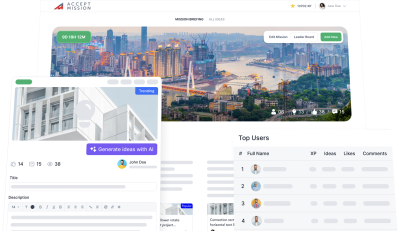
Accept Mission streamlines the entire process from launch to impact measurement. Everything happens in one place so you can focus on turning ideas into business results.
Here’s how Accept Mission supports your innovation challenges:
- Quick campaign setup: Launch challenges in minutes with customizable templates for internal, external, or hybrid formats
- Built-in gamification: Drive participation through leaderboards, points, badges, and undercover mode for anonymous submissions
- Custom evaluation tools: Set up digital scorecards with your specific criteria and invite multiple reviewers to rate ideas
- Automated workflows: Move winning ideas through smart funnels directly into project pipelines with timelines and milestones
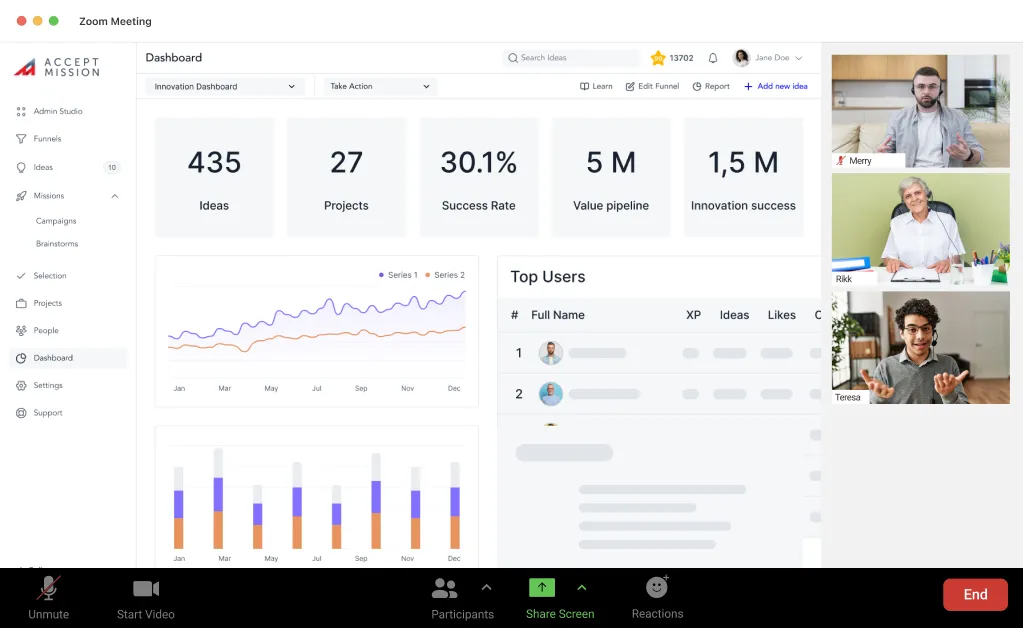
- Real-time dashboards: Track participation, engagement, and expected impact with dynamic reports and visualizations
- AI-powered insights: Get deep analysis of trends, patterns, and opportunities to make better decisions faster
The platform integrates the full innovation lifecycle so ideas don’t disappear after your challenge ends.
With workflow automation, you can trigger emails, assign tasks, and move projects forward based on smart conditions.
Ready to run innovation challenges that actually drive business results? Book a demo with Accept Mission today and see how the platform can transform your approach to innovation.
Our team will show you exactly how to set up, execute, and measure challenges that create measurable impact for your organization.

















 English
  Dutch
Dutch  Portuguese
  Spanish
  French
  German
  Arabic