
Intrapreneurship: How to Foster a Startup Mentality Within a Corporate Giant

Here’s the problem with success: The things that make your company dominant today are often the same things that will kill it tomorrow.
Big companies are great at protecting what they have. They build processes, create approval layers, and minimize risk. This works fine until a startup shows up and eats their lunch.
That’s where intrapreneurship comes in. It’s the practice of letting employees act like entrepreneurs inside your company.
They use your resources, your data, and your brand to build new things. But they think and move like startup founders, not like traditional employees.
What Intrapreneurship Actually Means
Intrapreneurship gets confused with regular innovation all the time. But they’re different things.
Regular innovation is often about making your current products better.
You improve features, cut costs, or add new variations. It’s important work, but it’s not the same as building something entirely new.
What Makes an Intrapreneur Different
An intrapreneur is an employee who builds new ventures inside your company. They work within your structure but think like founders.
The key difference from entrepreneurs is the safety net. Entrepreneurs risk their savings, homes, and livelihoods. Intrapreneurs use company money and resources.
This lets them take bigger swings without worrying about making payroll, but they might not feel the same urgency that keeps entrepreneurs up at night.
Here’s how the three types compare:
| Feature | Entrepreneur | Intrapreneur | Traditional Employee |
|---|---|---|---|
| Primary Driver | Independence & wealth creation | Innovation & corporate impact | Stability & career growth |
| Risk Profile | High financial/personal | Moderate career/reputation | Low |
| Resources | Scarce (external funding) | Abundant (corporate budget) | Allocated (cost center) |
| Decision Making | Autonomous/rapid | Negotiated/stakeholder alignment | Hierarchical/process-driven |
| Success Metric | Valuation/exit/profit | Revenue growth/strategic fit | KPIs/efficiency/compliance |
| Reward | Equity/ownership | Salary + bonus + recognition | Salary + annual raise |
| Failure Impact | Bankruptcy/business closure | Project cancellation/reassignment | Performance review impact |
This comparison matters because intrapreneurs need different support than traditional employees.
They need more autonomy, different metrics, and better incentives. Treat them like regular employees and they’ll either leave or stop innovating.
The Three Cultural Pillars That Make Intrapreneurship Work
You can’t buy innovation. You can’t mandate it in a memo. Culture drives everything, and three pillars hold up that culture.
Pillar 1: Psychological Safety (The Foundation Everything Else Sits On)
Psychological safety means people can take risks without fear. They can admit mistakes, ask dumb questions, or pitch wild ideas without getting punished for it.
Google’s Project Aristotle found this was the single most important predictor of high-performing teams.

According to Gallup research, organizations could potentially reduce turnover by 27% and increase productivity by 12% by improving psychological safety, specifically by increasing the percentage of employees who feel their opinions count from 30% to 60%.
Leaders create this environment through action, not words. They admit their own mistakes first.
They respond to failed experiments with curiosity instead of blame. If your employees think a failed project will tank their career, they’ll only propose safe, boring ideas.
Pillar 2: The “Learn Fast” Mindset (Not Just “Fail Fast”)
“Fail fast” has become corporate nonsense. Everyone says it, but most companies punish failure anyway.
The real goal isn’t to fail. It’s to learn fast. Learning fast means every project starts with a clear hypothesis. You state what you believe and what data will prove or disprove it.
Then you run cheap, quick experiments to test that hypothesis.
3M’s “15% Culture” lets employees spend 15% of their time on projects they choose.
This freedom helped Art Fry transform an accidentally discovered weak adhesive into Post-it Notes, which proves that 15% time can turn lab curiosities into breakthrough products.
But the failure only worked because it generated useful knowledge.
Pillar 3: Breaking Down Silos (Where Good Ideas Go to Die)
Innovation dies in silos. An engineer has a great idea but can’t get marketing resources. A salesperson sees a customer need but can’t reach the product team.
The bigger problem is often the “frozen middle.”
Middle managers are measured on operational excellence and predictability. Taking risks makes their numbers look bad, so they kill new ideas to protect their P&L.
To make intrapreneurship work, turn middle managers into venture capitalists for internal ideas.
Measure them on how well they develop talent and support experiments, not just on hitting this quarter’s budget. Cross-functional teams are non-negotiable.
Practical Frameworks: Three Approaches That Actually Work
Culture is necessary but not sufficient.
You also need proven methods that guide people through the innovation process. Here are three frameworks that actually work in corporate environments:
1. The Lean Startup Method (Adapted for Corporate Reality)
Eric Ries’s Lean Startup methodology is the gold standard for modern intrapreneurship. The core idea: reduce market risk through iterative testing before you spend millions scaling.
The heart of this approach is the minimum viable product, or MVP. It’s not a smaller version of your final product. It’s the smallest thing you can build to test your core assumption.
The goal is to measure customer behavior, not to impress them with polish.

The build-measure-learn loop drives everything. You build an MVP. You measure how customers respond. You learn what works and what doesn’t. Then you do it again.
In a startup, this loop might take a week. In a corporation, it often takes months due to legal reviews and compliance checks.
The most important part is the pivot. Sometimes the data tells you your original idea was wrong.
The team should have permission to make a fundamental strategy change based on what they learned, not get penalized for missing the original plan.
2. Adobe Kickbox: A Blueprint You Can Copy
Adobe created the most codified intrapreneurship system in the world. It’s called Kickbox, and any employee can participate.
The program comes in a literal red box.
Inside: instruction cards, notebooks, a Starbucks gift card, a chocolate bar, and a $1,000 prepaid credit card (that last item is the genius part).

The $1,000 card removes all friction. No approvals needed. No expense reports. Just test your idea. If you fail, you just cost the company $1,000.
That’s nothing compared to launching a product nobody wants.
The Kickbox process has six levels, but the investigation stage is critical. You must hit specific metrics: interview customers, drive 250+ visitors to a landing page, and get 25+ engagements.
This moves the conversation from opinion to data. Your boss might not like your idea, but 250 potential customers showing interest is hard to argue with.
3. Design Thinking: Making Sure People Actually Want It
Lean Startup tells you how to validate. Design thinking tells you what to validate.
It’s a human-centered approach built on three factors:
- Desirability (do people want it?)
- Feasibility (can we build it?)
- Viability (will it make money?)
All three matter.
The process has five stages: empathize, define, ideate, prototype, test.

The empathize stage requires leaving the building. You observe users in their natural environment to reveal needs that customers can’t articulate in surveys.
McKinsey research suggests blending Design Thinking with quantitative analytics yields the best results: qualitative research for human need, quantitative data for market opportunity validation.
Choosing the Right Innovation Structure
The truth is that structure matters.
You can’t just tell people to innovate and hope it happens. You need dedicated vehicles that give projects the right amount of autonomy and resources at each stage.
Different vehicles serve different purposes:
| Feature | Incubator | Accelerator | Venture Builder |
|---|---|---|---|
| Stage | Ideation/pre-seed | Seed/growth | Concept to scale |
| Duration | Flexible (1–5 years) | Fixed (3–6 months) | Long-term/permanent |
| Primary Goal | Develop ideas & teams | Accelerate growth/pilot | Build independent companies |
| Structure | Loose, mentorship-heavy | Cohort-based, structured | Institutional co-founding |
| Funding | Grants/salary coverage | Equity investment/grants | Significant capital injection |
Incubators: Space to Explore Early Ideas
Incubators focus on the earliest stage of innovation.
They give employees time and space to develop concepts without pressure for immediate revenue. They’re designed for exploration, not execution.
Key characteristics:
- Flexible timelines (1-5 years)
- Mentorship and resources for ideation
- Low-pressure environment for experimentation
- Focus on developing both ideas and teams
Incubators work best when you need to explore uncertain territory. They protect early-stage ideas from the pressure to show immediate ROI.
But there’s a risk:
Without clear milestones, they can become “success theater” where innovation activity looks impressive but produces no commercial output.
To avoid this, set clear validation gates that ideas must pass through to continue receiving support.
Accelerators: Speed for Validated Concepts
Accelerators are designed for speed.
They take existing MVPs and put them through an intensive 3-6 month program. This works when you already know the idea has legs and you just need to move faster.
Core elements:
- Fixed duration (typically 3-6 months)
- Cohort-based structure with peer learning
- Specific milestone targets (pilot launch, investment readiness)
- Access to corporate networks and resources
Accelerators push teams hard. You’re not exploring anymore. You’re validating and scaling.
The fixed timeline creates urgency and forces decisions. Use accelerators when you have proof of concept and need to hit specific market milestones quickly.
The cohort structure also creates healthy competition and knowledge sharing between teams.
Venture Builders: Co-Founding New Companies
Venture builders act as institutional co-founders.
They generate ideas internally, validate them, recruit teams (mixing internal talent with external entrepreneurs), and inject significant capital.
The venture operates as a separate legal entity.
What makes them different:
- Long-term commitment (not fixed duration)
- Substantial capital injection from day one
- Dedicated teams (not side projects)
- Separate legal entity with own governance
- Corporate retains significant equity stake
This model solves the agility problem. The venture gets startup-style freedom and speed.
But it keeps access to the parent company’s resources, distribution, and customer base. Venture Builders work best for ideas that could become standalone businesses but benefit from corporate backing.
The separate entity structure attracts entrepreneurial talent who want founder-level autonomy and upside.
The Hybrid Approach That Works
Most successful companies use a dispersed approach (everyone can innovate) combined with focused vehicles (dedicated teams to execute).
You run hackathons and idea campaigns to surface opportunities from across the organization. Then you funnel the best ideas into an accelerator or venture builder for execution.
This hybrid model worked for companies like Lockheed Martin with Skunk Works, Sony with their Startup Acceleration Program, and Mastercard with their Labs.
The key lesson:
Isolation protects innovation from bureaucracy, but integration ensures it serves the business strategy. Find the right balance for your context.
Solving the Incentive Problem: Why Money Matters (But Isn’t Everything)
Here’s the brutal truth: if you expect entrepreneurial risk but offer employee-level rewards, your best people will leave.
Entrepreneurs risk everything for the chance at life-changing wealth, while intrapreneurs might build a billion-dollar business and get a promotion and a bonus.
To retain them, you need specific incentive structures:
- Phantom stock: Cash payments tied to venture value without transferring ownership. An intrapreneur with 1% phantom equity in a $10M unit gets a payout when it sells for $50M.
- Profit sharing: Tied specifically to the venture’s P&L, not diluted company-wide, so teams share directly in what they generate.
- Milestone bonuses: Cash awards for hitting specific stages (first customer, first $1M revenue). Simple to administer but can encourage short-term thinking.
- Autonomy time: Google’s 20% time and 3M’s 15% time let people choose what to work on, signaling respect for intellectual curiosity.
- Career safety nets: Guaranteed return rights mean if the venture fails, employees get their previous job back at the same level.
- Recognition: Showcase successful intrapreneurs through executive presentations and internal platforms.
Money matters, but autonomy matters more to true innovators. Freedom is currency. Career safety nets remove the fear of failure and make people more willing to take the leap.
The combination of financial upside and non-financial recognition creates the complete package that keeps your best innovators from leaving.
Your Next Steps
Start small. Pick one framework to pilot, run cheap experiments, and scale what works.
Accept Mission helps you turn intrapreneurship theory into systematic execution, managing the full innovation lifecycle from campaigns to project portfolios.
Here’s how it supports your intrapreneurship program:
- Campaign Builder AI: Launch focused innovation challenges in minutes using AI-powered templates for specific business problems
- Smart funnels: Guide ideas through automated stage-gate workflows with scoring criteria, group decision-making, and progress tracking
- Gamification engine: Drive participation with leaderboards, XP points, badges, and undercover modes that make innovation engaging
- Project management: Convert validated ideas into tracked projects with timelines, resource allocation, and strategic alignment
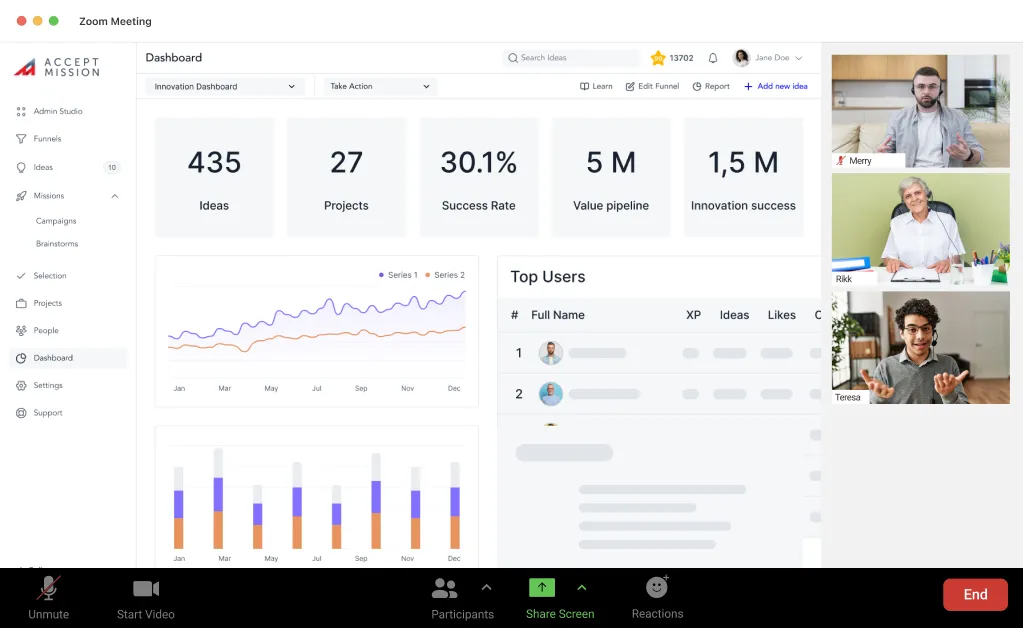
- Real-time dashboards: Measure impact with analytics on idea velocity, conversion rates, and portfolio ROI
- Integration ready: Connect with existing tools through SSO, Teams, SharePoint, and API for seamless workflows
The platform eliminates the friction hindering intrapreneurship programs, preventing ideas from getting lost and tracking project progress effectively.]
Companies using Accept Mission have collected thousands of ideas, engaged employees across 110+ countries, and turned validated concepts into funded pilots.
Book a demo with Accept Mission to build an intrapreneurship program that combines corporate scale with startup agility.


















 English
  Dutch
Dutch  Portuguese
  Spanish
  French
  German
  Arabic